

Postmortem: Network Consensus Halt, March 24, 2026
Status: Published
Date of incident: March 24, 2026
Severity: Critical -- network-wide consensus halt
Impact: No new data written to the protocol during the halt, reading data and streaming unimpacted.
Summary
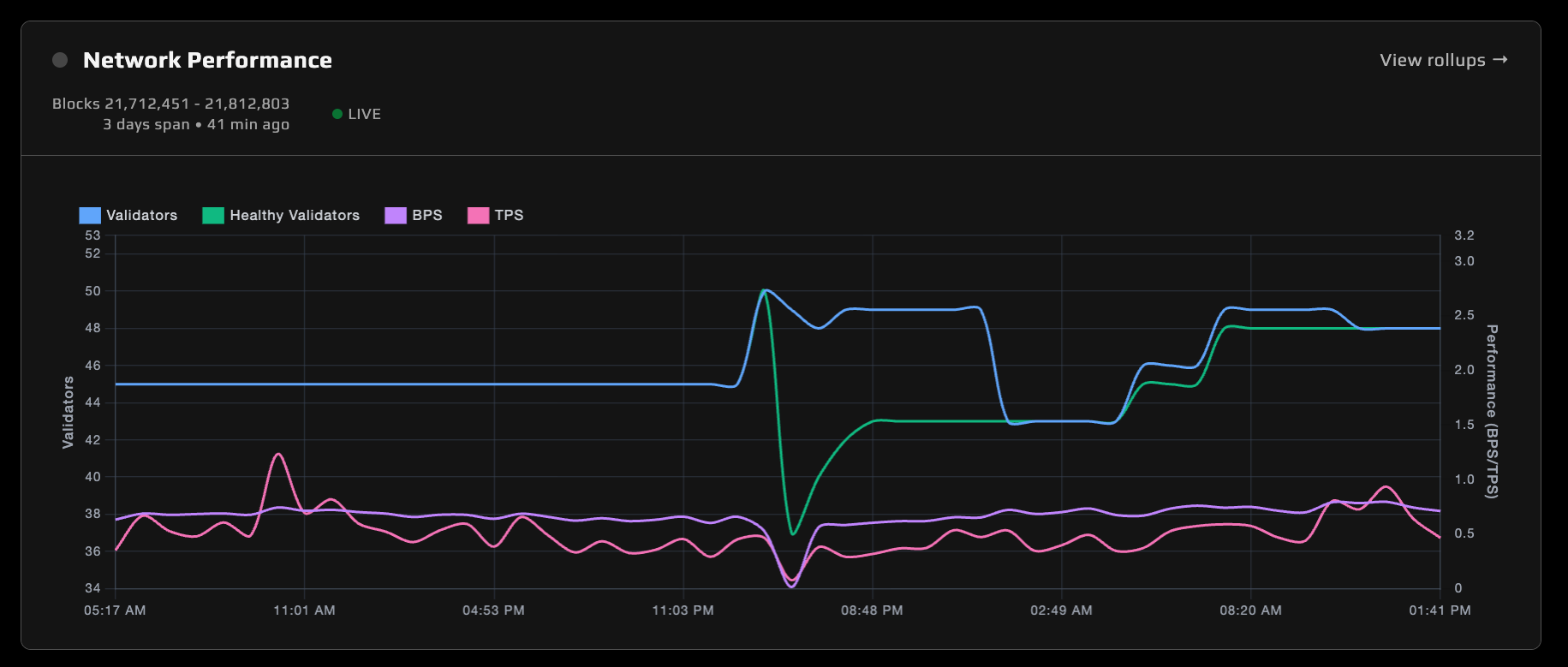
The Open Audio Protocol experienced a consensus halt starting the morning of March 24, 2026, the first of its kind in the history of the chain. It was detected at around 2am PT at nearly the same time by Figment and Audius teams.
Under the hood, the Open Audio Protocol leverages the CometBFT consensus engine to coordinate audio metadata updates and streaming use in its core package. The halt was caused by a cascade of independent failures that collectively dropped the active validator set below the 2/3+ supermajority threshold required. The contributing factors were:
(1) A validator operator with substantial stake and node count changing DNS that silently reduced participation
(2) A separate operator's accidental infrastructure deletion that simultaneously downed many validators before they could be jailed or consensus-deregistered
(3) A handful of validators present in CometBFT's consensus state but missing from core_validators application state, due to legacy registration bugs, which complicated normal return to service
Recovery required a database migration to correct the validator set, coordination with multiple staked validator operators to restore availability, and a protocol-level change to accelerate CometBFT round progression to health the network more expediently.
The network fully recovered at 4:47 PM PDT on March 25, 2026.
Timeline
Background
Validator Registration and core_validators
The Open Audio Protocol maintains a core_validators table in PostgreSQL that tracks all registered validators. Each row stores the validator's public key, endpoint URL, Ethereum address, CometBFT internal address, and service provider ID. This table is the application's source of truth for who is in the validator set.
Validator registration is a multi-step process that bridges Ethereum L1 and the Audio L1:
- A node operator registers on the Ethereum staking contract.
- The node's registry bridge detects its own Ethereum registration and submits a registration transaction to the Open Audio chain.
- Other validators attest to the registration via multi-signature quorum.
- Once the attestation is finalized in a block, the validator is inserted into
core_validatorsand aValidatorUpdateis delivered to CometBFT, adding the node to the consensus set.
Critically, both the core_validators insert and the CometBFT ValidatorUpdate must happen together. If one succeeds without the other, the application and consensus engine disagree on who is a validator, which can lead to degredation as nodes may not agree on validator set when computing SLA rollups.
Jailing and the SLA Rollup System
The Open Audio Protocol implements design decisions to favor availability in the effort of allowing modern streamining DSPs to operate close to their web2 counterparts' capabilities.
Validators are expected to actively participate in block production. The protocol tracks this through SLA (Service Level Agreement) rollups:
- At a configured block interval (currently set to 2048 blocks), the block proposer creates an
SlaRolluptransaction covering the recent block range. - The rollup contains a
SlaNodeReportfor each active validator, recording how many blocks that validator proposed during the interval. - All validators independently compute the same rollup from their local state. If a proposed rollup doesn't match what a validator computes locally, it rejects the transaction.
A "validator warden" process periodically checks the last 8 SLA rollups for each validator. If a validator proposed zero blocks across all 8 rollups, it is jailed: a ValidatorDeregistration transaction (with Remove = false) is submitted to consensus, which sets the validator's jailed flag to true and delivers a power-zero ValidatorUpdate to CometBFT. Jailed validators are removed from active consensus but retain their database record and can re-attest to unjail themselves. This allows for CometBFT to maintain a higher block production rate despite having delinquent validators.
This jailing mechanism is relevant to the incident because the SLA rollup validation utilizes the core_validators application state to verify validity. Prior to the incident, but undetected, core_validators listed 45 validators but CometBFT had 50 in its set. This led to proposals requiring a 34 node supermajority with only visibility into 45 nodes. The ability for a rollup to be validated was therefore reduced.
Blocks and Rounds in CometBFT Consensus
CometBFT produces blocks through a propose-prevote-precommit cycle. For each block height, a designated proposer creates a block and broadcasts it. Validators then vote in two phases (prevote and precommit). If 2/3+ of voting power agrees, the block is committed. This is a single round.
If consensus fails in a round, because the proposer is offline, too few validators respond, or votes don't reach supermajority, the protocol advances to the next round with a different proposer. Each phase has a configurable timeout, and importantly, these timeouts grow linearly with each round:
timeout = base + (round × delta)The Open Audio Protocol configures these as:
| Phase | Base | Delta |
|---|---|---|
| Propose | 400ms | 75ms |
| Prevote | 300ms | 75ms |
| Precommit | 300ms | 75ms |
In round 0, the full cycle takes roughly 1 second. By round 100, each phase has grown by 7.5 seconds, making a single round take ~23.5 seconds. By round 1000, a single round takes over 3.5 minutes. This linear backoff is designed to give slow nodes time to converge, but it becomes a serious obstacle during recovery from a halt. Nodes must advance through every intervening round sequentially, each one slower than the last.
While per-round timeouts grow linearly, the cumulative cost is quadratic. The total time to advance through N rounds is:
Σ(r=0..N-1) [1000 + 225r] = 1000N + 225·N(N-1)/2Notably when a node restarts, it resets to round=0 and has to catch up through every intervening round sequentially, each one slower than the last, leading to a several hour max recovery time to a round 1000+ halt, which is what this incident saw.
Root Causes
1. Simultaneous Node State Deletion
A validator operator (theblueprint.xyz) had a disk cleanup routine that unintentionally pruned the CometBFT chain state directory, causing a CometBFT/Postgres state mismatch across their 17 nodes; while blob storage remained fully intact, the nodes became unable to participate in consensus.
2. Reduced Validator Participation (DNS Change)
A validator operator (previously known as cultur3stake) changed their DNS configuration to rehome all of their nodes under open-audio-validator.com, causing most of their validators to become unreachable to the rest of the network due to the registration process. Only one of their validators had made it into consensus by the time of the incident (https://val001.open-audio-validator.com/). This silently reduced the effective voting power without good detection. open-audio-validator.com has substantial stake on the network and runs 20 nodes.
3. Stale Validators in CometBFT State
Five validators existed in CometBFT's consensus validator set but were missing from the application-level core_validators table. These validators were originally registered via a legacy registration path that did not write to validator_history. Their core_validators rows were lost during a deregistration/re-registration cycle where the DB insert was skipped (duplicate detection) but the CometBFT ValidatorUpdate was still delivered.
CometBFT saw 50 validators while core_validators listed 45—mostly a mismatch for SLA rollups, artificially inflating the supermajority threshold.
4. CometBFT Round Timeout Accumulation
CometBFT increases consensus round timeouts linearly: timeout = base + (round * delta). With default delta values of 75ms, a node that needs to catch up through hundreds of failed rounds accumulates significant delays (e.g., round 1000 x 75ms = 75 seconds per round step). This made recovery painfully slow even after the validator set issues were addressed.
Impact
- Full consensus halt -- no new blocks produced between March 24 1:57 AM PDT and March 25 4:47 PM PDT (38 hours and 50 minutes)
- Failing writes -- All downstream services and applications issuing write operations were impacted by the halt.
No impact to reading data or streaming occurred during the halt.
Patches Deployed
-
Missing validator migration (
go-openaudio:v1.2.5) -- SQL migration to add the 5 stale validators back intocore_validators, aligning the application-level validator count with CometBFT's consensus state. -
Configurable consensus timeout deltas (branch:
rj-fast-roundviago-openaudio:5782b161791cdcd800a058d701e02113ae47ec80-amd64) -- Environment variables (OPENAUDIO_TIMEOUT_PROPOSE_DELTA,OPENAUDIO_TIMEOUT_PREVOTE_DELTA,OPENAUDIO_TIMEOUT_PRECOMMIT_DELTA) to reduce the per-round timeout increment, allowing nodes to catch up through many failed rounds faster during recovery.
Released formally in go-openaudio:v1.2.6.
Prior Related Work (pre-incident)
- Consensus-based validator deregistration (March 12,
go-openaudio:v1.2.2–go-openaudio:v1.2.4) -- Replaced direct DB manipulation with consensus transactions to keep CometBFT and application state in sync. This was a preventive fix that addressed the class of bug that created the stale validators, but did not retroactively fix the existing inconsistency.
Contributing Factors
- No alerting on validator set divergence -- The mismatch between CometBFT and
core_validatorswas not visible in monitoring until the incident - Silent validator dropout -- DNS changes and node wipes produced no on-chain warnings; the network only failed when it crossed the supermajority threshold
- Legacy registration path -- The old registration flow did not maintain consistent state across all tables, creating the conditions for stale validators
- Narrow effective fault tolerance -- DNS misconfiguration plus a correlated infrastructure wipe left the network close to the supermajority boundary
Action Items
| Priority | Action | Status |
|---|---|---|
| P0 | Deploy cleanup migration for go-openaudio:v1.2.5 along with round timing configuration, improvements to node registration process, and better /console information | Done (go-openaudio:v1.2.6) |
| P1 | Add better monitoring/alerting for CometBFT vs. application validator set divergence | TODO |
| P1 | Add alerting for validator participation drop below safety threshold | TODO |
| P1 | Audit legacy registration paths for other state inconsistencies | TODO |
| P2 | Document validator operator runbook for DNS changes and infrastructure maintenance | TODO |
| P2 | Treat correlated outage exposure as a metric (e.g. validators / voting power sharing operator, DNS zone, or ops boundary)—not only per-operator stake caps | TODO |
| P2 | Continue development of the "proportional rewards" feature that will dispurse additional rewards to node operators that are unjailed and able to complete storage proof challenges | TODO |
Lessons Learned
- State consistency between consensus and application layers is critical. Any path that modifies one must modify both atomically, or have reconciliation mechanisms. The prior fix to use consensus-based deregistration addressed this going forward, but the pre-existing inconsistency was only caught when it contributed to a halt.
- The network's fault tolerance margin was narrow—especially after correlated loss of many live validators; the small app vs. Comet validator mismatch did not help but was secondary.
- CometBFT's linear timeout backoff is hostile to recovery. After hundreds of missed rounds, the accumulated timeouts make catching up prohibitively slow without intervention.
- Validator operator coordination is a first-class operational concern. DNS changes, infrastructure maintenance, and node resets need to be communicated and staged to avoid compounding failures.
- Validator count does not equal true fault tolerance. Multiple validators run by the same operator, DNS, or on shared infrastructure can still fail together. We need not just stake caps, but also better monitoring, participation alerts, and processes to avoid single points of failure.
- The network only disincentivizes bad behavior through social slashing. The protocol team is actively developing a feature to dispurse additional rewards to node operators that are unjailed and able to complete storage proof challenges. This will be a key tool for the network to incentivize good behavior and reduce the risk of future consensus halts as well as reliable storage.
- In future, we recommend that node operators with multiple nodes in their fleet perform maintenance or infrastructure changes in a pharsed or staggered manner to avoid compounding failures and socialize changes.
Slashing
How slashing works, example slash calldata, and links to the staking UI and dashboard are documented under Slashing on the Staking page.
Gratitude
🙏
We are grateful to the following teams for their assistance in investigating and resolving the incident with a high level of urgency, ownership and care for the protocol and its users:
- theblueprint.xyz
- cultur3stake
- Figment
- TikiLabs
- Altego
- Many other indepdent node operators, including but not limited to: Super Cool Labs, audiusindex.org, rickyrombo.com, monophonic.digital, shakespearetech.com, audius-nodes.com